The AI platform shift is the most profound technological moment since the advent of the cloud. Every founder, executive, and investor believes this to be true, hence why the market is flooded with capital ready to fund the next breakthrough. But within this gold rush of innovation, a singular, critical challenge persists: a lack of consensus on the most effective AI pricing model.
We see this uncertainty every day. Founders are building products with unparalleled potential while grappling with volatile compute costs and nebulous value propositions. Buyers, eager for productivity gains, are hesitant: frustrated by opaque pricing models, unpredictable bills, and lingering concerns over security and risk.
As a leading AI investor with deep ties to the enterprise, our role is to move beyond hype and provide the grounded insights to support business success. We’ve been tracking the conversation around AI pricing for the better part of a year now. In an effort to gain clarity around current AI pricing standards and practices, we recently surveyed our network of 300+ startup and enterprise executives.
The result is our first AI Pricing Report. Here’s what the data told us.
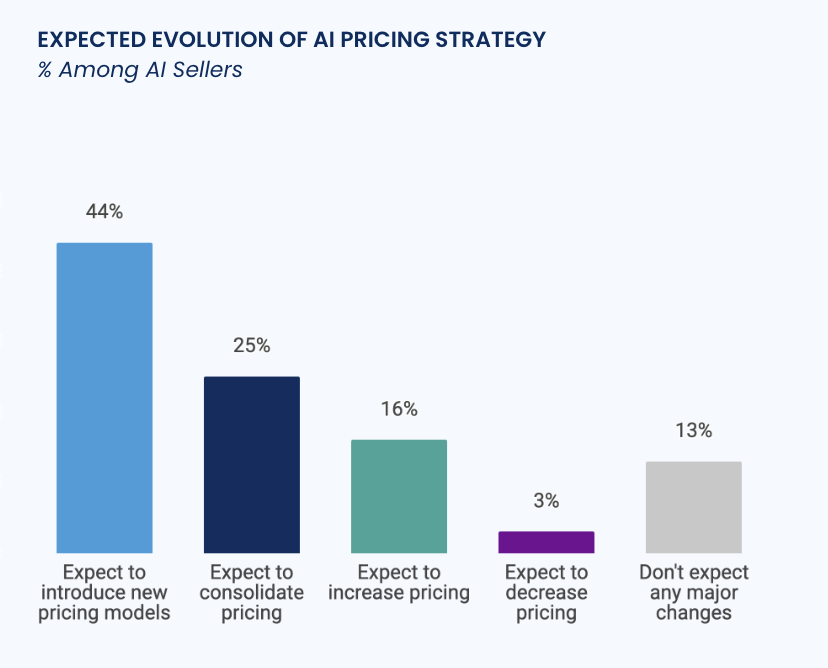
According to our survey, 87% of AI sellers plan to change their pricing in the next 12-18 months. In other words, there’s far from a consensus in the market on what the best pricing model is — and the uncertainty is costing everyone.
Buyers reported feeling frustrated by unpredictable bills and opaque cost structures. Sellers said they’re struggling to communicate value before customers experience it firsthand. Both sides are operating without standardized benchmarks needed to close the gap and engender trust.
“What frustrates me the most is the transparency issue of the current AI pricing model. The price of AI tools is not clear, and there may even be price fluctuations and hidden fees. This makes it very difficult for us to accurately predict the final input during budget planning, resulting in resource allocation and decision-making becoming less efficient and orderly.” – anonymous survey respondent
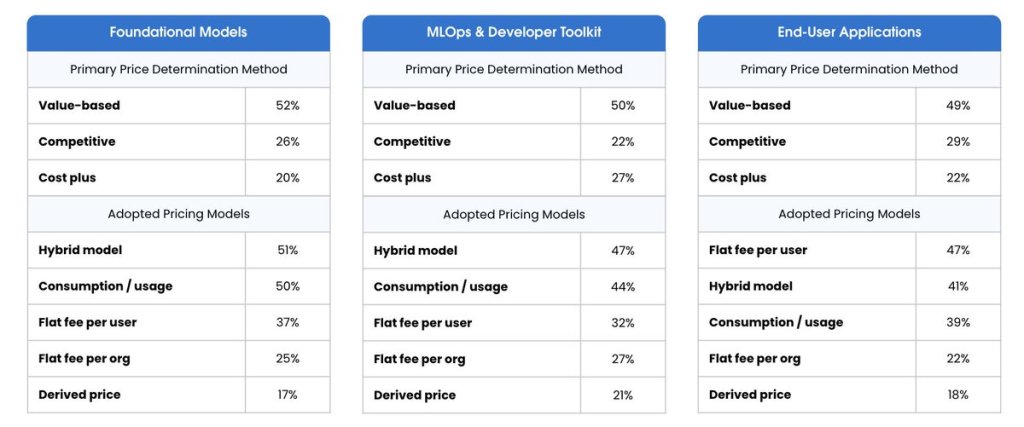
Despite uncertainty, a clear pattern is emerging. Over half of AI sellers now use a hybrid pricing model — typically a flat base fee combined with consumption-based charges above a usage cap. Per respondents, it’s the model of choice because it addresses three things buyers care about most: value, predictability, and fairness.
Pure consumption models are popular (utilized by 23% of sellers), but they create the exact kind of billing unpredictability that buyers rank as their #1 frustration.
As such, the market is converging on a hybrid — at least for the time being.
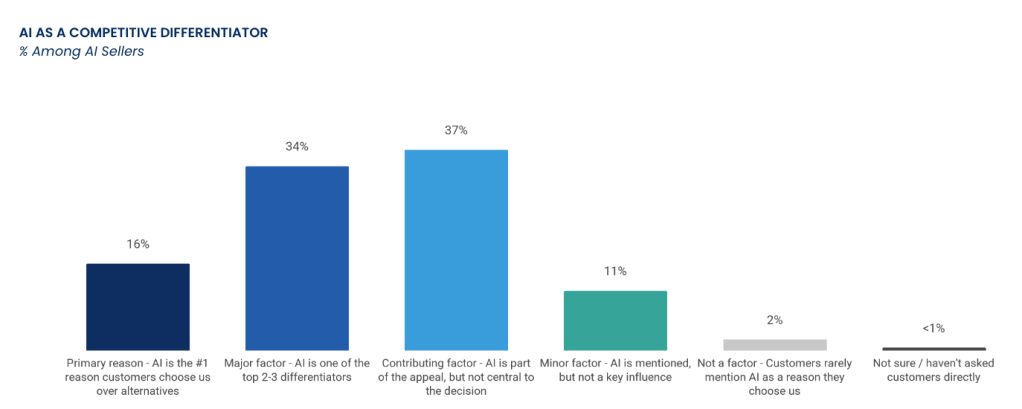
Only 16% of AI sellers say AI capabilities are the primary reason they believe customers choose them over alternatives. More than a third say it’s “one of several factors.” Another 37% say it’s a contributing factor but not central to the decision.
While sentiment around AI is changing at the speed of every new model release, our view is that enterprises have moved past the baseline question of “does this product utilize AI?” and are now asking “does this AI product reliably deliver outcomes I can measure?” In short, the bar has shifted from novelty to proof of ROI.
“To determine ROI of our AI investments, we track quantifiable changes to the product development cycle and impact on increasing revenue and reducing business operation costs.” – anonymous survey respondent
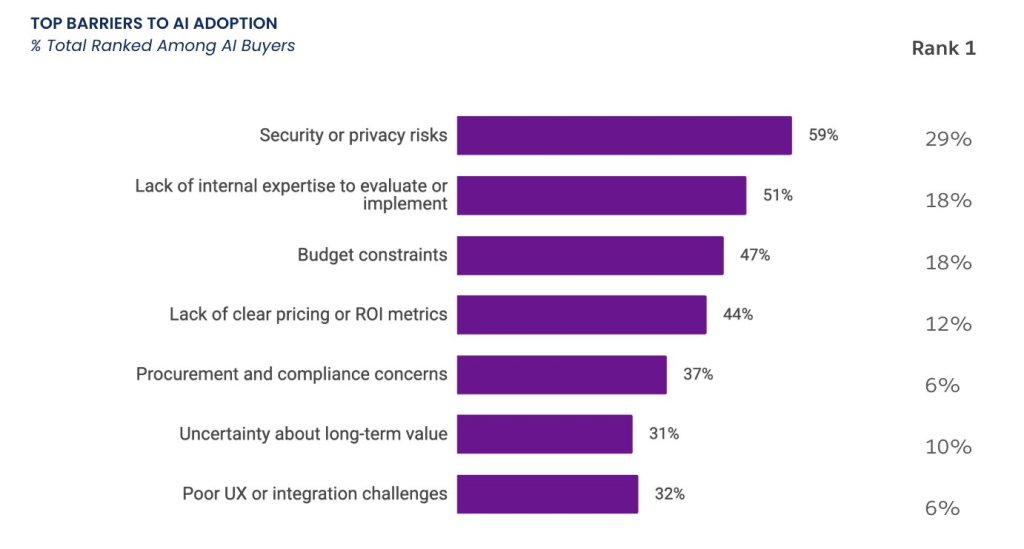
AI buyers’ #1 adoption barrier is security and privacy risk (cited by 59%). Their top pricing frustration is a lack of transparent ROI metrics. The sellers with the highest confidence in their pricing models are consistently the largest and most mature companies (possibly because they’ve had more time to prove value and build credibility).
In our experience with enterprise buyers, pricing friction is usually a symptom of a deeper trust deficit. Founders who treat pricing as purely a financial exercise are missing the point.
What founders should do
The AI market moves at a breakneck pace. What works today may be rendered obsolete tomorrow. However, when it comes to AI pricing, we believe founders who lead with value, commit to transparency, and give buyers the tools to predict and control their spend will win — regardless of what the broader market settles on.
For comprehensive insights and guidance on the state of AI pricing, download our AI Pricing Report →